
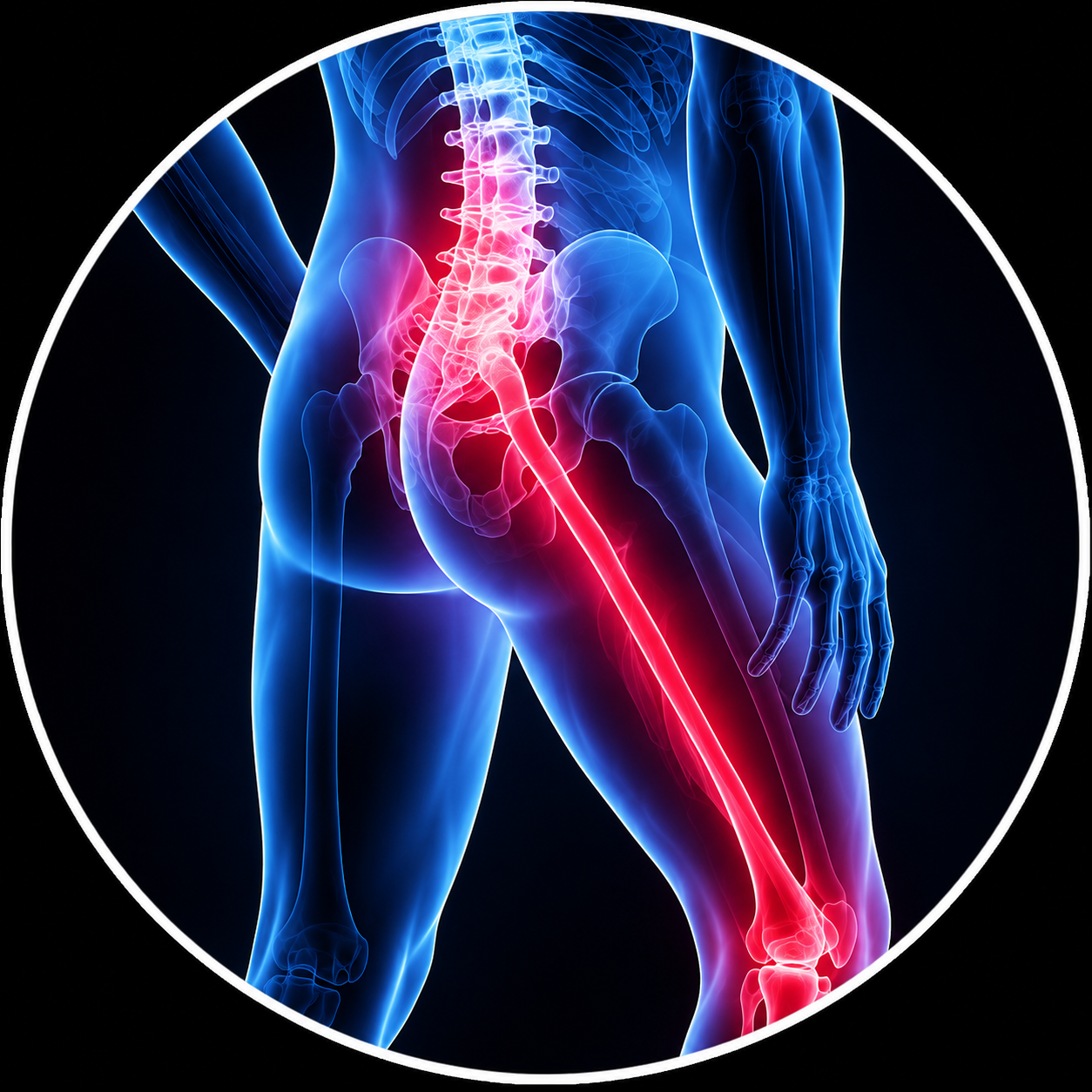
Low Back Pain & Sciatica Relief in Sacramento
Most people call any pain in the low back, hip,
or leg "sciatica," whether it actually involves
the sciatic nerve or not.
Understanding what's actually causing your pain,
not just where you feel it, is the first step toward real relief.
Ready to Feel Better?
Call (916) 333-1166 today, or fill out our new patient form below and we'll reach out to confirm your visit. We look forward to helping you move better, recover better, and function better.
The Wellness Spa of Arden • Serving Sacramento Since 1993
Move Better. Recover Better. Function Better.
Curious how we think about pain in general? Read our philosophy →

"Is It Really Sciatica?"
In nearly every new patient history, leg or hip pain gets the same label: sciatica. Sometimes that's accurate. Often, it isn't.
Pain can show up in very different ways
depending on where it's actually coming from:
- Sharp, electric, or burning pain that travels down a clear path, often with numbness or tingling, usually points to a nerve being irritated
- A deep, vague ache that's hard to pinpoint often comes from the joints or discs themselves, not a nerve at all
- Pain that shows up in one place but is actually coming from somewhere else entirely, like hip pain that's really a back problem, is more common than most people realize
- A tender, tight knot in a muscle can also send pain down the leg or into the hip, mimicking sciatica without involving a nerve at all
Each of these requires a different approach.
Calling everything "sciatica" doesn't help you
get better. Understanding what's actually
happening does.
What Causes Low Back Pain & Sciatica What Causes Low Back Pain & Sciatica
Low back pain and sciatica can develop for many different reasons, and they often overlap.
Common contributing factors include:
- Tight or restricted hips that force the low back to compensate
- Acute injury from lifting, sudden movements, or sports
- Sleeping in an awkward position
- Prolonged sitting, especially with poor posture
- Old injuries that never fully resolved
- Disc irritation or joint restriction in the low back
- Weak or imbalanced core and hip muscles
- Repetitive strain from work, sports, or daily activity
Sacramento patients often develop low back pain from long commutes, extended desk work,gardening, golf, pickleball, and other activities that place repeated stress on the hips and spine over time.
After treating Sacramento patients since 1993, one of the most common patterns I see is tight hamstrings pulling on the pelvis, which in turn pulls on the low back muscles. Over time, this creates chronic tension and eventually pain, even though the hamstrings were the actual starting point.
Because these causes often combine, treating only the area of pain can miss what's actually driving it.
While most low back pain is musculoskeletal, part of a thorough evaluation is determining whether your symptoms are actually coming from the spine, hips, surrounding soft tissues, or another source entirely. If your condition requires a different type of care, appropriate referral recommendations will be discussed.
Why the Hips Are Often the Real Problem
Many low back problems are actually movement problems involving the hips, pelvis, and surrounding muscles that eventually create stress in the low back.
When the hips don't move the way they should, whether from tightness, old injuries, or simply sitting too much, the low back ends up doing work it wasn't meant to do. Over time, that compensation becomes the source of pain.
This is also where the "sciatica" label gets confusing. Tight hip muscles, particularly the piriformis, can mimic sciatic nerve pain almost exactly, sending discomfort down the leg without the sciatic nerve being involved at all.
Treating the low back alone, without addressing hip mobility, often means the same pain keeps coming back. Identifying whether the real driver is the back, the hip, or both changes the entire approach to care.
What About Disc Problems and SI Joint Issues?
Disc herniations and SI joint dysfunction get blamed for a lot of low back pain, and sometimes they're the actual cause. Often, though, they're not.
It's common to have a disc bulge or SI joint irritation show up on imaging without that being the actual source of your pain. The body is complicated, and structural findings don't always match symptoms.
Studies have shown that some old disc injuries can actually heal over time. What often remains afterward isn't the disc injury itself, but surrounding muscles, ligaments, and joints that never fully regained their strength and stability. People can end up living in fear of an old injury that's already healed, while the real ongoing issue is the support system around it.
When a disc or the SI joint genuinely is contributing to your pain, care is adjusted accordingly, often with a gentler approach and closer attention to movement patterns that protect those structures while still addressing the surrounding muscles and joints.
The key is not assuming. An evaluation helps determine whether a disc, the SI joint, the hips, the surrounding muscles, or some combination is actually driving your symptoms.
Our Approach to Low Back Pain & Sciatica Relief
Care begins with figuring out what's actually driving your pain, not just where you feel it. Every patient is evaluated individually. Treatment is based on what we find, not a standard protocol applied to everyone.
Depending on your condition, care may include:
- Chiropractic adjustments to restore motion in the low back, pelvis, and hips
- Soft tissue therapy to release tight muscles, including the hips, glutes, and hamstrings
- Movement-based rehabilitation to improve hip mobility and core stability
- Guidance on activity modification and safe return to lifting, sports, or daily tasks
- Stretches and exercises you can do at home to maintain progress
When the hips, low back, and surrounding muscles are all addressed together, results tend to be more complete and longer lasting than focusing on the low back alone.
The goal is not just temporary relief. It is identifying what's driving the problem so you can move better, feel better, and stay that way.
Who This Care Is For

Low back pain and sciatica-type symptoms affect
people differently depending on their lifestyle
and history. This care may be a good fit if you are:
- An athlete dealing with low back tightness or recurring strain
- A busy parent who's developed back pain from
lifting kids, car seats, or daily demands
- A gardener or active adult who wants to keep
doing the activities they love without pain holding them back
- Someone whose low back pain developed
gradually with age, as joints and discs naturally change over time
- Someone with an old injury, including a past
disc injury or auto accident, that never fully resolved
- Someone who sits for long periods at work or
during a commute
If you've been told your low back pain or leg pain is "just sciatica" without much explanation beyond that, an evaluation can help clarify what's actually going on, and what to do about it.
Conditions Commonly Associated With Low Back Pain & Sciatica
- Sciatica
- Herniated or bulging disc
- SI joint dysfunction
- Piriformis syndrome
- Degenerative disc disease
- Hip impingement
- Facet joint irritation
- Muscle strain and chronic tension
When Should You Seek Care Immediately?
Most low back pain is musculoskeletal and responds well to conservative care. However, certain
symptoms may indicate a more serious condition requiring immediate medical attention.
Seek emergency care if you experience:
- Loss of bowel or bladder control
- Progressive weakness in one or both legs
- Numbness in the groin or inner thigh area
- Significant trauma such as a fall or accident
- Unexplained fever with back pain
- Unexplained weight loss alongside back pain
These symptoms are uncommon but important to recognize. When in doubt, seek immediate
medical evaluation.
Common Questions Sacramento Patients Ask About Low Back Pain & Sciatica
- Why does my low back hurt when I stand up?
- Why does pain shoot down my leg?
- Can tight hips cause sciatica?
- Why does my back hurt after sitting all day?
- Can a chiropractor help a bulging disc?
- How do I know if my pain is from my hip
or my back?
Frequently Asked Questions
Is sciatica always caused by a herniated disc?
No. While a herniated disc can cause sciatica, leg and hip pain often come from other sources, including tight muscles like the piriformis, joint irritation in the low back, or referred pain that has nothing to do with a disc at all. An evaluation helps identify the actual cause.
I was told I have a pinched nerve. Can a chiropractor help with that?
In most cases, yes! As a Sacramento chiropractor, I focus on identifying what's actually irritating the nerve, whether it's a disc, a tight muscle, or restricted joint movement, and addressing that directly rather than just treating the symptom.
What does numbness or tingling down my leg mean?
Numbness and tingling often point to nerve involvement, though the source can vary. It may come from the low back itself, from tight muscles like the piriformis compressing the nerve, or from other contributing factors. An evaluation helps determine the actual source so the right approach can be taken.
How many visits does it typically take to feel relief?
This varies depending on how long the issue has been present and what's contributing to it. Some patients feel improvement quickly, while chronic low back pain that has built up over years may take longer to fully resolve.
I've had this on and off for years. Can you still help?
Usually, yes! We may not always be able to fully resolve an issue that's been present for years, but in most cases we can make meaningful improvement. We'll have a much clearer picture after a thorough examination, including whether the hips, the low back, or both are contributing to the problem.
Is it safe to get adjusted if I have a disc issue?
In many cases, yes! Appropriate movement is often an important part of recovery from many disc-related conditions. Think of it like a rusty hinge on a door, the hinge needs to move, even if it's a little stiff, or the door stops working altogether. The approach is always tailored to your specific situation. Some patients with disc involvement still benefit from adjustments performed in a modified, more comfortable way. In other cases, soft tissue work and rehabilitation may be emphasized instead. Your comfort and safety always factor into the plan.
Do you only treat the low back, or also the hips?
Both, and often the hips are just as important. Since hip immobility is frequently a major contributor to low back pain, addressing only the back without the hips often leads to the same pain returning.
Can tight hamstrings cause low back pain?
In many cases, yes. Tight hamstrings can alter pelvic mechanics and increase tension throughout the low back. While they aren't the cause of every case of back pain, they are one of the most common contributing factors we find
during evaluation.
Can tight hips cause low back pain?
Absolutely! Restricted hip mobility often forces the low back to compensate during walking, bending, lifting, and sports. Over time this can increase stress on the low back and contribute to pain and stiffness.
Ready to Find Out What's Really Going On?
If low back pain or leg pain has become something you just live with, or if you've been told it's "just sciatica" without much explanation, an evaluation can help identify what's actually driving the problem.
Ready to Feel Better?
Call (916) 333-1166 today, or fill out our new patient form below and we'll reach out to confirm your visit. We look forward to helping you move better, recover better, and function better.
We regularly help patients from Sacramento, Arden-Arcade, Carmichael, Fair Oaks, Citrus Heights, Rancho Cordova, Orangevale, Gold River, East Sacramento, and surrounding communities find lasting relief from low back pain, sciatica, disc injuries, and related conditions.